
Overview of Trends of Persecution Against Bahá’ís in Iran
(June 2025 - June 2026)
The Bahá’í community, Iran’s largest non-Muslim religious minority, has faced state-sponsored, systematic persecution since the 1979 Islamic Revolution. As the Bahá’í Faith is not recognized under the Iranian Constitution, Bahá’ís are denied fundamental rights and subjected to discrimination as outlined in a 1991 memorandum, to marginalise and eradicate their community. This includes arbitrary arrest
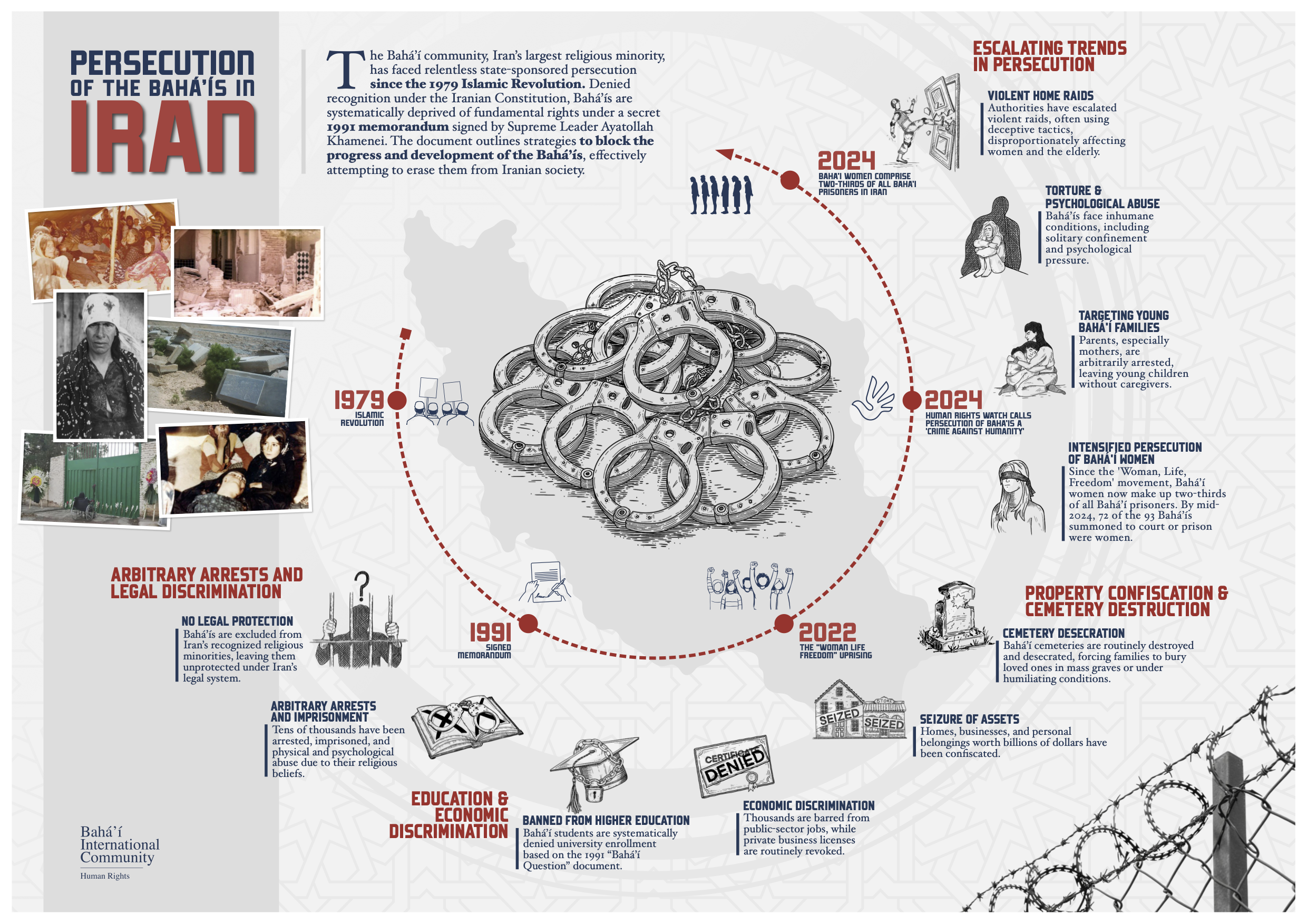
s and imprisonment, home and business raids, systematic exclusion from universities, confiscation of properties and assets, economic strangulation and banning of employment, cemetery destruction, mass hate propaganda through the state’s media machinery, and more.
Over the past year, the persecution of Bahá’ís in Iran has intensified in a number of ways. In particular, since the January 2026 protests and February outbreak of conflict, there has been a widening series of human rights attacks by the authorities in Iran. More than 400 recent cases of state-sponsored human rights abuses against Bahá’ís across Iran, including arrests and detentions, violent home raids, unlawful property seizures, and obstructions to justice by judicial authorities, among other human rights violations, have been reported.
The following trends and patterns have been observed from June 2025 to the present:
1. Scapegoating in Times of Crisis: Mock Executions, Torture, Forced Confessions and Incitement to Hatred
During every period of national crisis since the 1979 Islamic Revolution – whether social, economic, or political – the Iranian authorities have consistently and systematically scapegoated the Baháʼí community. This has taken the form of fabricated allegations, coordinated disinformation and state-driven hate campaigns. This strategy seeks to divert attention from internal issues and to justify further coercive measures against the community.
In recent months, Iranian authorities have once again activated a long-standing and deliberate strategy of scapegoating members of the Bahá’í community at a time of heightened instability. Arrests and detentions of Bahá’ís have risen sharply, accompanied by coercing some detainees into forced confessions. Alarmingly, two Bahá’ís have been subjected to mock executions and torture.
Two young Bahá’ís, Peyvand Naimi and Borna Naimi faced mock executions and severe torture. These cases must be understood within a broader context: the effort by the Iranian government to use Baháʼís as scapegoats for the January 2026 protests and the February outbreak of conflict, consistent with its long-standing pattern of persecution, including through state media and escalating repression. As such, these cases are emblematic of the threat facing Baháʼís across the country.
Mock Executions and Torture
Two of the most egregious of these cases concern Peyvand Naimi, a swimming athlete, who was arrested on 8 January on false charges of instigating unrest and was held in an Islamic Revolutionary Guard Corps facility before his transfer to prison. Peyvand was tortured for at least 10 consecutive days. He was bound hand and foot for 48 hours, denied food and water, and endured two mock executions. As of the time of writing, he remains in Kerman Prison and is being held without due process.
Peyvand’s cousin, Borna, a karate champion and father of a three-year-old child, was detained on 1 March. The Revolutionary Guards agents interrogating him subjected him to electric shocks, causing severe burns to his feet and legs, as well as two mock executions.
Mock executions are severe forms of mental torture and are banned under international law.
Forced Confessions and Incitement to Hatred
Amid the February outbreak of conflict, multiple programmes broadcast on Channel 2 state television disseminated false and inflammatory accusations against the Baháʼí community. These broadcasts included clearly forced confessions obtained from Baháʼís under detention.
On 1 February, the so-called “confessions” of two Bahá’ís, relating to the protests – confessions that are manifestly obtained under pressure and coercion – were broadcast by Islamic Republic of Iran Broadcasting (IRIB), the regime’s principal state media outlet, Channel 2. Human rights organizations have for many years documented the practice of forced confessions in Iranian prisons, where detainees are pressured, threatened and even tortured into giving false confessions against themselves, and broadcasting such forced confessions on state television is a major escalation in the Iranian government’s campaign against the Bahá’í community.
While in prison, Borna Naimi was forced to sign a false confession implicating himself and his cousin, Peyvand Naimi, in the killing of Basiji guards during the 8 January protests. No evidence exists for this charge, and neither Borna nor Peyvand could have committed these crimes, as they occurred after Peyvand had been detained and while Borna was surrounded by family at home. The text of his forced confession had been prepared beforehand and handed to him to read.
2. Rise in Arrests, Detentions and Imprisonment
At the same time, reports indicate a sharp increase in arrests and detentions of Baháʼís across the country, suggesting a coordinated campaign of intimidation and persecution.
Since the January 2026 protests, dozens of Baháʼís have been detained or imprisoned, solely for their beliefs, in multiple locations across Iran. The detainees are held in a combination of standard prisons, intelligence detention centres, other IRGC-run facilities and some in unknown locations. Many have been exposed to physical and psychological abuse, including lengthy abusive interrogations, sustained periods in solitary confinement, beatings and electric shock torture, mock executions, forced confessions and denial of access to essential medical treatment and medications. A number of the detained individuals are being held in undisclosed locations, raising serious concerns regarding transparency, due process, and access to legal representation.
In addition to those physically incarcerated, there are more Baháʼís currently serving sentences outside prison with electronic monitoring ankle bands or on temporary leave.
Individual Bahá’ís are suffering medical emergencies resulting from prolonged solitary confinement and denial of medical care, as well as extreme stress at being held without access to their families, legal counsel, or due process.
Disproportionate Targeting of Bahá’í Women
Women constitute the majority of the detainees, and several are held in facilities operated by the IRGC or intelligence services, indicating that these detentions are security related and, in these cases, motivated only by the detainee’s religious beliefs.
In one alarming case, Boshra Mostafavi, a pregnant Bahá’í woman from Rafsanjan, was detained and jailed in recent months. First arrested several years ago, Boshra Mostafavi was acquitted due to insufficient evidence, but prosecutors appealed the ruling and had it overturned on 25 April 2026. She was then incarcerated again, putting her life and that of her unborn baby at risk. While she was ultimately released on bail, her case is illustrative of the authorities’ complete neglect of the welfare of vulnerable women.
Additionally, Shakila Ghasemi, a 26-year-old woman from Kerman, detained for over 100 days and held in solitary confinement for at least 10 weeks, is also among the dozens who have been jailed in recent months. Shakila has had little to no contact with her family since her 2 February arrest, after her home was raided by plainclothes agents and her belongings seized.
3. Incitement to Hatred
Since the 1979 Islamic Revolution, the Iranian government has devoted vast financial and human resources to the systematic production and dissemination of anti-Bahá’í propaganda. Through state-controlled and state-affiliated media—including television, radio, newspapers, and, in recent years, social media platforms—the authorities have sustained a relentless campaign of incitement and vilification. Each year, hundreds of thousands of pieces of anti-Bahá’í content are produced and circulated, the overwhelming majority through state-sponsored websites, media outlets, and social media channels. This extensive machinery of propaganda has sought not only to justify the persecution of the Bahá’ís but also to normalize hatred and discrimination against them throughout Iranian society.
Anti-Bahá’í Exhibitions
Since April 2026, in a marked escalation of state-sponsored anti-Bahá’í sentiment, Iranian authorities have launched a series of coordinated, anti-Bahá’í public exhibitions across multiple cities in Iran, organised with direct involvement from government ministries, municipal authorities, senior clerical figures and state media. The exhibitions have toured squares and public parks in multiple cities across Iran, including Qaemshahr, Babol, Sari and Baherstan, accompanied by a sustained digital campaign of incitement on social media. Far more than a conventional media campaign, these exhibitions transform prejudice into a visible, participatory and state-sanctioned public experience, with children and young people being targeted.
State-sponsored anti-Bahá’í propaganda is not new. Every period of social, economic and political national crisis in Iran has repeatedly been accompanied by efforts to scapegoat the Bahá’í community through false allegations, coordinated disinformation and hate campaigns. For decades, Bahá’ís have been labelled as a “deviant sect”, falsely accused of “espionage on behalf of Israel” and portrayed as “agents of foreign power.” Such narratives have served to legitimize discrimination and persecution while fostering hostility towards the Bahá’í community within wider society in Iran.
The exhibitions expose a fundamental contradiction between Iran’s longstanding position on the prohibition of religious defamation and its systematic defamation of the Bahá’í Faith within its own borders. They also constitute a targeted effort to cultivate religious prejudice among children and young people. This development represents both a continuation and an escalation of the Iranian authorities’ longstanding pattern of state-sponsored incitement to hatred against the Bahá’ís.
State-Driven Incitement to Hatred and Violence: 12-Day War June 2025
An aggressive and dangerous state-driven narrative was unleashed by the Islamic Republic’s Cyber Army, leveraging the June conflict to advance unsubstantiated allegations that Bahá’ís are somehow affiliated with, and actively collaborating with Israel. This hate propaganda not only justifies further repression by the state’s machinery but encourages mob violence and crimes against the Baháʼís by the public with complete impunity.
This coordinated propaganda campaign surged across media platforms with close ties to the state, fuelled by the widespread dissemination of disinformation. Alarmingly, Bahá’ís have been threatened, with references to the 1988 mass execution of political prisoners in Iran, known as the "summer of ’67" in the Iranian calendar. The campaign also promotes disturbing rhetoric, calling for mass surveillance of Bahá’ís “from 9-month-old infants to 90-year-old elders” an indication of its intent to monitor and dehumanize the entire community and portray even the most vulnerable as threats to society.
Such propaganda appears to be part of a broader strategy to lay the groundwork to incite hatred and violence, while providing a pretext for authorities to carry out mass arrests of Baháʼís without evidence or due process. This represents a dangerous evolution in Iran’s persecution of Bahá’ís, shifting from institutional discrimination to the incitement of societal violence.
4. Obstructions to Justice
Iran’s judiciary has played a central role in the persecution of Bahá’ís through arbitrary arrests, unfair trials, lengthy prison sentences, and the denial of due process. Following the Israel-Iran conflict in June 2025, the crackdown intensified significantly. Between June and November 2025, the BIC documented more than 750 persecutory acts – three times the number recorded during the same period in 2024 – including over 200 raids, at least 110 arrests, and prison sentences of up to ten years.
These violations reflect a longstanding state policy of discrimination against Bahá’ís, implemented through the justice system. Detainees are frequently arrested without warrants, denied access to legal counsel and essential medication, and subjected to prolonged interrogations, while defense lawyers face restrictions on access to evidence and families are routinely denied accountability regarding detention conditions.
Over the past year, authorities have imposed harsh sentences following grossly unfair trials, reopened cases after acquittals, and pursued retrials despite Supreme Court decisions overturning convictions. A particularly concerning example is the reopening of criminal proceedings against 26 Bahá’ís in Shiraz after they had been acquitted, highlighting the use of the justice system as a tool of repression rather than an independent guarantor of rights.
On November 12, security forces in Gorgan arrested Farhad Fahandej after searching his home and seizing his personal belongings. His whereabouts, the reason for the arrest, and any charges against him remained unknown for weeks after the arrest. Additionally, in October 2025 in Semnan, Anisa Fanaian, a Bahá’í mother imprisoned in the past for her faith, was convicted of vaguely-worded charges and sentenced to eight years in prison. The verdict came after the Supreme Court had overturned a lower court verdict against her, following a judicial review request, and sent the case back for retrial.
5. Home Raids
Bahá’í homes across Iran are systematically targeted by searches and raids, often violent in nature, carried out by intelligence agents, frequently without prior notice or legal warrants. During these raids, personal belongings are routinely confiscated, including religious items such as Bahá’í books, documents and photographs, and items of value including mobile phones, computers, cash, gold, jewelry, property deeds, identity documents and passports.
Raids have been conducted in the early morning or late at night by large numbers of agents, deliberately timed to catch occupants in a disoriented and vulnerable state. Reports consistently describe the presence of armed and plainclothes intelligence agents, sometimes numbering in the dozens. Reports further indicate that agents routinely employ verbal insults, threats, physical assault, and armed intimidation during these operations. In multiple cases, raids have been conducted by IRGC and Basij militia personnel, often without valid court warrants.
Such unlawful use of force endangers all occupants of the household. Of particular concern is the impact on older and medically vulnerable residents. Elderly Bahá’ís, including those with serious health conditions, have been subjected to these invasive and violent operations, causing psychological trauma.
6. Confiscation of Property and Assets
Increasing cases of property and asset confiscation reflect a systematic pattern of economic persecution aimed at impoverishing Bahá’í families and dismantling livelihoods across generations. These measures are not limited to those facing active charges: individuals with no pending proceedings, those already imprisoned, and those previously acquitted have all been subjected to confiscation and asset seizure.
Legal instruments intended for legitimate public purposes have been misused as tools of persecution. Article 49 of the Iranian Constitution, which empowers the state to seize property gained through illicit means, has been systematically invoked against Bahá’ís to seize lawfully owned homes, businesses, agricultural land, vehicles and bank accounts, without evidence, due process, or meaningful opportunity for legal challenge.
In August 2025, the BIC reported that over 20 other Bahá’ís, also in Isfahan, were under threat of losing all their belongings in the same way. Many of the Bahá’ís were informed of these confiscations simply by an SMS, outside of any formal legal due process.
One case involved the confiscation of a large pistachio farm owned and cultivated by a Bahá’í family for decades. The judicial proceedings against the family were grounded not in any credible legal violation, but explicitly in their religious beliefs and community activities, including allegations of hosting gatherings and promoting the Bahá’í Faith. The farm was sealed by intelligence and law enforcement agents, the harvest forcibly seized and sold, and the family left without recourse. The physical and psychological toll on family members was severe. The case is part of a broader pattern in which the judicial process is rendered arbitrary, stripping Bahá’ís of any meaningful avenue for legal defence.
7. Denial of Access to Higher Education
For decades, the Iranian government has systematically excluded Bahá’ís from higher education. This policy is rooted in a 1991 memorandum of the Supreme Revolutionary Cultural Council, which explicitly instructs that Bahá’ís “must be expelled from universities once their religion is identified”. In 2023, a mandatory declaration form was introduced requiring applicants to renounce their beliefs and disassociate themselves from Bahá’í institutions as a condition of enrolment, a direct violation of both Iran's constitutional provisions and its international human rights obligations.
Bahá’í students have continued to encounter barriers at the earliest stages of the admissions process. Reports indicate that online registration systems for university entrance examinations still fail to accommodate applicants who do not identify with one of Iran's four officially recognised religions, effectively preventing Bahá’í students from completing registration altogether. This administrative exclusion reflects the continuation of a long-standing pattern of structural discrimination, ensuring that successive generations of Bahá’í youth are denied equal access to education.
8. Economic Strangulation
Economic displacement and strangulation cut across diverse sectors, spanning employment, businesses ownership, property and agricultural land, and have formed a central feature of the policy of discrimination against the Bahá'í community. This policy is consistent with the 1991 government memorandum, which explicitly instructs authorities to “deny them employment if they identify themselves as Bahá’ís.”
Over the past year, the Iranian government has intensified its campaign of economic strangulation against the Bahá'í community. Bahá'ís continue to face systematic exclusion from employment, and authorities have increasingly targeted their businesses, ordering closures for indefinite amounts of time. In July 2025, several Bahá'í business owners in Shiraz faced summons and legal action, resulting in the temporary closure of 8 shops – including automobile repair, photography, and retail businesses – ranging from 10 days to a full month.
Bahá'ís have also faced business raids and confiscation of personal belongings at their workplaces. On 20 August 2025, the IRGC's intelligence branch conducted coordinated raids from 7:30 am on 20 homes and businesses of 11 Bahá'ís in Isfahan, targeting a single district. In some cases, agents used violence, ignored judicial warrants, and seized personal property, including money and jewelry, underscoring efforts to economically impoverish the community.
9. Destruction of Bahá’í Cemeteries and Violation of Burial Rights
Iranian authorities have long waged, or condoned, a systematic campaign against Bahá’í cemeteries through vandalism, destruction, and restricted access, demonstrating that even sacred burial grounds are not protected from state-sponsored hostility. Over the past year, the erosion of Bahá’í burial rights has intensified, with families often denied access to designated burial grounds, subjected to excessive burial fees, and forced to endure prolonged delays in recovering the bodies of their loved ones. In some cases, individuals have been buried without their families’ knowledge or consent.
Authorities have also increased surveillance and restrictions at Bahá’í cemeteries, limiting the community’s ability to access, maintain, and preserve burial sites, while preventing families from visiting the graves of their loved ones.