BIC Joins World Leaders in Qatar to Consult on Strengthening Social Development



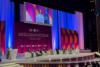
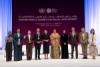


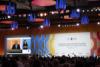
The Second World Summit for Social Development, held recently in Doha, Qatar, marked a significant moment for the global social development agenda, drawing some 14,000 participants from around the world and from the Arab region in particular. Key figures included 40 Heads of State or Government and over 230 ministers and senior officials. And the Bahá’í International Community (BIC) played a role in organizing key parts of its proceedings.
As Chair of the subcommittee focused on the Summit, within the context of the NGO Committee for Social Development, BIC Representative Cecilia Schirmeister co-led efforts to organize the two day-long Civil Society Forum that took place during the Summit.
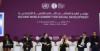
Ms. Schirmeister moderated the Forum’s Opening Panel, sharing the stage with dignitaries including Annalena Baerbock, President of the 80th Session of the United Nations General Assembly; Lok Bahadur Thapa, President of the United Nations Economic and Social Council for the 2025-2026 Session; Buthaina bint Ali Al Jabr Al Nuaimi, Minister of Social Development and Family of the State of Qatar; Amina J. Mohammed, Deputy Secretary-General of the United Nations; and Co-facilitators of the Doha Political Declaration Sophie de Smedt, Ambassador of Belgium to the UN, and Omar Hilale, Ambassador of the State of Morocco to the UN. Civil Society representatives Roberto Bissio, International Secretariat of Social Watch, and Gillian D’Souza Nazareth, Chair of the NGO Committee for Social Development, also spoke on the panel.
Reflecting on the global conversation taking place, Ms. Schirmeister shared that “What’s becoming clearer in the collective consciousness is that true development is not something to be carried out by one part of the world, on behalf of another. Rather, all countries are on a joint path of learning together about what prosperity at its fullest entails and requires. And this Summit stood as a moment where all regions of the world could share their respective insights and experiences on what advancing development in their diverse contexts looks like.”
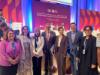
Ms. Schirmeister was joined on the BIC’s delegation to the Summit by several other BIC representatives and collaborators from the BIC’s Offices in Cairo, Geneva, and New York, as well as by the Bahá’í Chair for Studies in Development based at the Devi Ahilya University in India.
“It is highly significant that this Summit is being hosted here within the Arab world,” said Hatem El-Hady, Representative of the BIC Cairo Office. “It reflects the many Arab actors and indeed Arab societies striving to advance gender equality, social inclusion and cohesion, the eradication of poverty, decent employment, and the many other noble aims of social development.”
Members of the BIC delegation were pleased to connect with prominent figures in fields of policy-making, women’s empowerment, gender equality, and social development throughout the region, including from Egypt, Qatar, Kuwait, Jordan, the United Arab Emirates, and Bahrain.
In summary recorded remarks, BIC Representative to the Geneva Office Saba Haddad spoke, in Arabic, about the significance of the Summit and requirements for the path ahead.
“We observed [at the Summit] a genuine desire for collective action to find effective solutions, centering on human dignity, capacity building, and directing humanity’s potential energies toward the prosperity of all humanity,” Ms. Haddad said.
“We leave this global Summit carrying hope and determination to work together in a united spirit towards the material and spiritual prosperity of all humankind.”
The Summit marked the 30th anniversary of the first World Summit for Social Development, which took place in Copenhagen, Denmark in 1995. It was, at its time, the largest gathering of world leaders ever assembled.