BIC Participates in AU-EU Agriculture Ministerial Conference to Advance Sustainable Food Systems


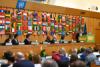
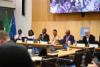

The Bahá’í International Community’s (BIC) Addis Ababa and Brussels offices jointly participated in discussions on just, sustainable, and resilient agri-food systems at the 6th African Union (AU) - European Union (EU) Joint Agriculture Ministerial Conference. The conference brought together African and European ministers and ambassadors of agriculture—representing almost half the world's agriculture ministers, and almost two billion people—as well as AU and EU commissioners, farming organisations and United Nations (UN) agencies, to strengthen the collaboration between the two Unions, and address current challenges facing both continents’ agri-food systems.
The BIC had the opportunity to engage in several bilateral conversations with AU and EU ministers and commission staff, and national farmer representatives, to explore further how the application of new technology, adjustments to improve sustainability, and efforts to address the immediate causes of food insecurity, will fall short if they are not accompanied by a critical rethinking of the foundational principles and underlying assumptions that guide agri-food practices and policies, from the local to the international level.
The BIC was among a small number of civil society groups, NGOs, and farmer organisations present at the conference, participating as part of the Food Systems Working Group of the Civil Society Engagement Platform (CSEP)—which facilitates knowledge-sharing and dialogue, and acts as an interface between civil society and intergovernmental structures and processes of the AU-EU Partnership.
The platform had already been meeting for several months, ahead of the conference, to strengthen its understanding of the implications an interconnected world has on agri-food systems. The group’s deliberations have also been exploring how effective policy reforms can be guided by a commitment to the well-being and prosperity of both continents—and, indeed, all of humanity.
The CSEP organised a side-event at the conference, which welcomed over 40 participants, including ministers, ambassadors, and former commissioners. Opening the side-event, Advocacy Lead from Alliance2015, Adriana Opromolla, said "Today is an opportunity to reflect on how the vision of the AU and the EU can converge in ways that promote transformation, guided by the realities of farmers and communities.”
The Just Economy Program and Policy Manager for Oxfam in West Africa, Francis Agbere, added that the AU-EU Partnership should “adopt policies that reduce inequality, enhance climate and environmental justice, and promote good governance and fairer trade rules, so that international trade can also benefit smallholder farmers.”
The Belgian Permanent Representative to the UN Rome-based agencies, Mr. Lieven De la Marche, shared that “agriculture is a transversal issue and no single actor can solve the challenges alone.”
In elaborating on the role of governments in generating consensus and a unified vision for national plans related to the agri-food system, the Irish Agriculture Attaché to the UN Rome-based agencies, Mr. Peter Cleary, said, “it’s necessary to have buy-in from all involved.”
Reflecting on the conference, Representative of the BIC's Addis Ababa Office, Shemona Moonilal, remarked that "given the centrality of agriculture to humanity’s well-being, the two continents would need to refine their shared framework with a unified voice, underpinned by the overarching principle of humanity's oneness.”
“It is essential that the relationship between the AU and the EU allows for both continents to prosper, and is based on the conviction that the well-being of the two regions is inextricably linked" added Representative of the BIC’s Brussels Office, Alessandro Benedetti.
Earlier this year, the BIC’s Brussels Office also addressed a letter to the EU Commissioner for Agriculture and Food, Mr. Christophe Hansen, elaborating on these themes, and held a discussion series which highlighted the intrinsic connections binding the needs of people in one region or group to those of another.
The Bahá’í International Community’s participation at the Ministerial conference reflects its engagement in discussions on agri-food topics, highlighting the need for a system that prioritises the well-being of all.