Breakfast Dialogues Provide Neutral Space to Discuss Sustainable Development Goals
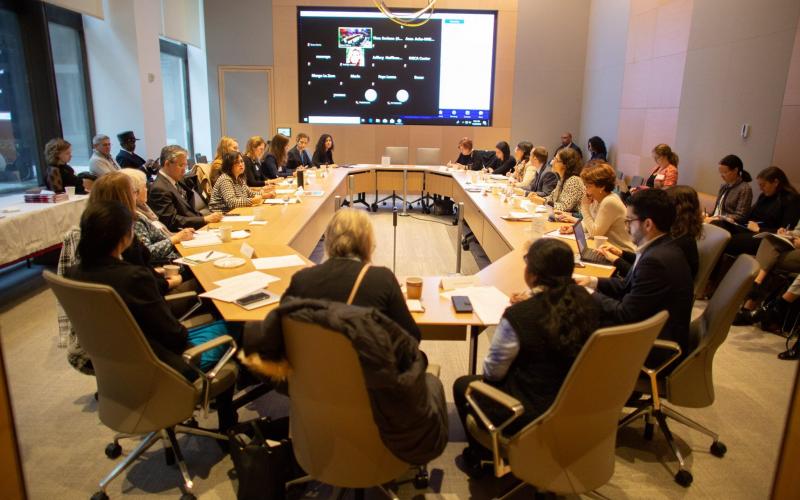
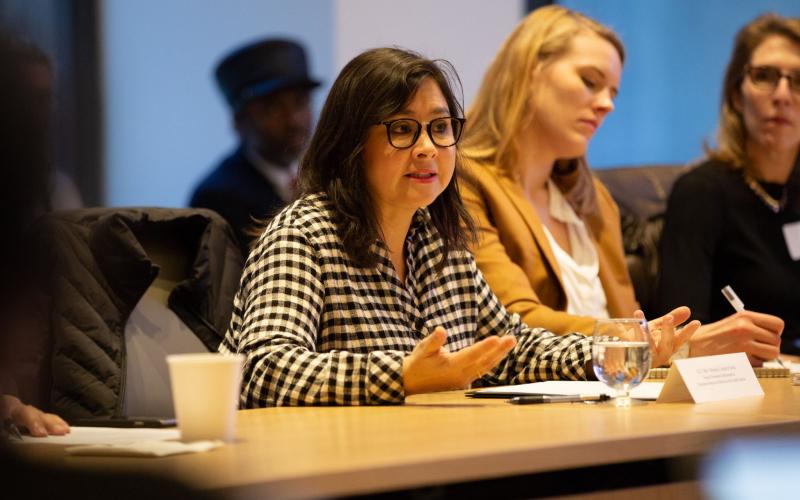
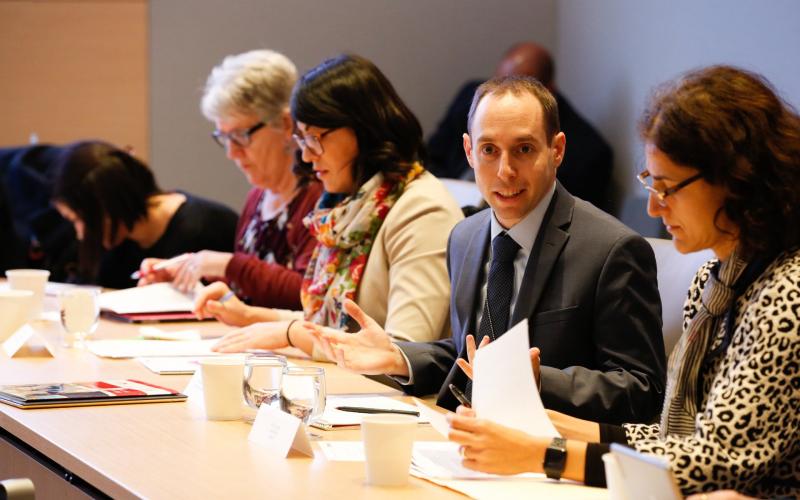

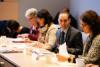
The Baha'i International Community and partners are hosting a series of breakfast dialogues to discuss the Sustainable Development Goals (SDGs).
The meetings provide a neutral and open space for UN officials, Member States and civil society to discuss progress made on the Goals in the lead up to the High Level Political Forum in 2019, where they will be reviewed.
“The objective of these meetings is to create spaces for the genuine exchange of ideas, sharing of successes and articulation of challenges with respect to the SDGs,” explained Daniel Perell, Representative of the Baha’i International Community to the United Nations.
“The hope is to have an atmosphere where all feel comfortable to share knowledge and experiences generated by our institutions and where all are open to learning from others so that we can freely discuss the needs of humanity in a spirit of shared endeavor.”
Participants focused on reviewing SDG 4— access to quality education— at a recent breakfast dialogue held at the Baha’i International Community’s United Nations Office in New York in collaboration with WaterAid, the Education and Academia Stakeholder Group and the UN Department for Economic and Social Affairs Division for Sustainable Development Goals (UNDESA/DSDG).
Among the guests included the Deputy Permanent Representative of the Permanent Mission of Bolivia to the UN, Verónica Cordova Soria, who shared experiences from Bolivia and articulated why it is important to view progress of the SDGs in an integrated manner.
“SDG 4 is the best example of how it is impossible to achieve one goal without achieving others. Without access to education we cannot eliminate poverty and hunger. It is only through education that we can reduce social inequalities and bring about peace, justice and strong institutions,” said the Ambassador.
"We agree that we need quality education, but it is harder to agree on what quality education is. All children need to be enrolled in school at the primary and secondary levels, but what kind of education are children receiving? What skills and values are being taught? As a mother, these issues interest me much more than just statistics."
The views were echoed by Astra Bonini of UN DESA DSDG who stressed the importance of interlinkages between the SDGs.
“Educational advances alone may not result in solving some of the problems if other goals are not met,” said Ms. Bonini.
“We know women have been advancing in terms of education quite a bit, but the labor market participation rate has not nearly kept pace with the tertiary education of women...that is why looking at multiple goals and policies are important.”
Lily Gray, a Liaison Officer with UNESCO warned that there was still a long way to go in terms of advances in education.
“262 million children and young people globally remain out of school,” said Ms. Gray citing UNESCO data, adding that even where there is sufficient enrollment, the quality of education can be a concern.
Based on the discussion, one contributor during the conversation shared that the language in SDG 4 does not reflect a values-based approach.
“I think we would all agree that the systems and structures of society themselves require transformation and that education is critical to enabling rising generations contribute towards these changes. In particular, they need to learn the values of justice, trust and others to help build systems that are not corrupt. Yet criteria around values is notably lacking in the language of SDG4,” she shared.
“This breakfast dialogue makes me wonder how many governments are invested in seeing things change and how many are too entrenched in the current paradigm to support its transformation.”
___
Are you a UN official, Member State delegate, or member of civil society interested in participating in our breakfast dialogues to review the SDGs? If so, contact [email protected]