Peacebuilders—not victims: Geneva panel hears that women of faith play key role in overcoming hate speech


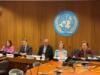

The Office of the High Commissioner for Human Rights (OHCHR) and the Geneva Centre for Human Rights Advancement and Global Dialogue (GCHRAGD) co-hosted a high-level panel, “Countering Hate Speech at the Intersection of Religion and Gender: Challenges and Pathways Forward,” featuring remarks by a Baha’i International Community (BIC) representative on the sidelines of the 59th Session of the Human Rights Council.
The event, timed to observe the International Day for Countering Hate Speech, drew more than 100 attendees, representing 28 United Nations Member States, civil society organizations, and other stakeholders, who heard from a panel of experts discussing challenges and solutions for addressing hate speech at the intersection of religion and gender.
The panel was co-chaired by Mr. Michael Wiener, Human Rights Officer at OHCHR, and Dr. Umesh Palwankar, Executive Director of the Geneva Centre. Panelists included Dr. Saba Haddad, BIC Representative to the UN in Geneva, H.E. Ambassador Marie-Thérèse Pictet-Althann, Permanent Representative of the Sovereign Order of Malta, and Ms. Adriana Quiñones, Deputy Director of UN Women in Geneva.
Stressing the importance of acknowledging the resilience and power of women of faith, and referring to examples from around the world, Dr. Haddad said, “it is crucial to move beyond a narrative that sees women solely as victims,” adding that “in the face of intense persecution, we have witnessed women of faith demonstrating extraordinary resilience and acting as powerful agents of constructive change and peace.”
Women’s resilience in the face of persecution
Highlighting the resilience of women in the face of persecution, Dr. Haddad looked at the story of a group of women in Yemen, empowered by a Baha'i-inspired organization, who addressed local needs by launching health campaigns benefiting hundreds, restoring school facilities to ensure girls can continue education and contribute to their communities. The women’s efforts had also extended to active participation in women-led peace networks, Dr. Haddad said, creating collaborative platforms for conflict resolution and ensuring women’s voices are integral to rebuilding the fabric of society. Through these initiatives, “these women become active peacebuilders in their communities, proving that those targeted by hate can be powerful agents of change.”
Pathways forward: prevention through a new culture of equality
Hate speech can be prevented by creating a new culture of equality, Dr. Haddad added. Transforming society is not only about new laws or policies, she said, adding that it requires a fundamental shift in values and a shared commitment to building more united communities around the world. This begins with an “unwavering commitment to the foundational spiritual principle of the equality of women and men,” highlighting that “the oppression of women is not just an injustice to women, it is a detriment to all of humanity, holding back its collective progress,” she said. And she underscored the vital role of religious communities in this transformation, where spiritual principles like equality can be put into practice for the benefit of all.
As an example, Dr. Haddad pointed to the United Arab Emirates, where interfaith gatherings have evolved beyond token expressions of tolerance to become spaces for leaders and community members to explore shared principles such as justice, mercy, and compassion. “By focusing on these unifying values, they demonstrate that when people unite around a shared commitment to higher ideals, they can overcome deep-seated differences and work together for the betterment of society,” she said.
Ms. Quiñones meanwhile addressed the rapid rise in hate speech targeting women, particularly those from religious or ethnic minorities, and emphasized how this trend undermines democracy, human rights, and social cohesion. Digital technologies were exacerbating the issue, she said, while also pointing to efforts countering the spread of hate speech such as a recent conference in Kenya on hate speech in electoral contexts and digital gender-based violence online.
A shared endeavor
Ambassador Pictet-Althann emphasized the crucial need for cooperation among governments, international bodies, local and regional communities, as well as religious communities and organizations. Many foreign ministries have dedicated sections addressing religious affairs, including the promotion of women’s rights, he said.
Dr. Haddad closed by noting that resilience to hate speech is an integral part of the collective endeavor to build peaceful and just societies. A future in which women can meaningfully engage as equals in all fields of human endeavor is the destination toward which humanity must now advance, she said, adding that this requires recognizing religion as a source of moral empowerment, ensuring the full participation of women, and supporting practical grassroots efforts that drive lasting transformation.