Statement by Daniel Perell on Our Common Agenda and enhancing international cooperation
Daniel Perell, a Representative to the United Nations (UN) for the Baha’i International Community, shared this statement at the fifth session of the thematic consultation convened by the President of the 76th Session of the UN General Assembly on Secretary-General António Guterres’s report, Our Common Agenda, on the subject of "Enhancing international cooperation". His remarks have been edited for publication.
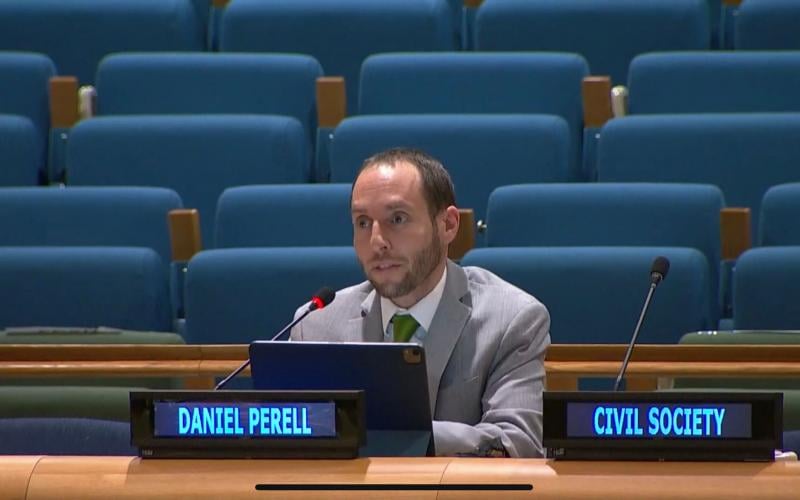
I wish to thank the President of the General Assembly for hosting these dialogues. This moment demands of us all a new kind of deliberation and a new time horizon.
I will start with a question for the panel and then offer a few reflections of context.
The question is: What does a truly long-term approach to change look like to you?
As I and my colleagues from both the Baha’i International Community and the Coalition for the UN We Need have been listening to all five of these dialogues, we notice the tensions of a number of dichotomies:
How do we balance the need for urgent action with the profound, time intensive shifts in thinking and behavior that are necessary?
How do we balance an order built on state sovereignty with the pragmatic demands of our global interdependence?
We hear the tendency to call for new agencies, institutions and processes, and there are hundreds of worthy proposals; and yet, one of the gaps we see most often is not a missing agency or institution, but a lack of implementation even of those agreements that are already made.
And then, of course, there is a call for meaningful civil society participation in these and similar discussions so as to enhance international cooperation, to be followed, by some, with the response of state-led processes.
Too often we become mired in these dichotomies, settling on one side or the other, thus losing the opportunity for meaningful dialogue. But perhaps we do not need to draw such a bold distinction; perhaps we can be both urgent and patient, innovative and efficient, and can acknowledge the true breadth of civil society’s role without negating the essential role of the state in these international processes. We can, perhaps, see that truth accepts many different realities at one time.
I would like to suggest that we detach ourselves from the current structures of our global institutions – and acknowledge that we are in a chapter of human history with no parallel which demands of us a posture we have never before taken or seen.
These dialogues, convened by the President of the General Assembly in response to the Secretary-General’s report, represent an opportunity to take the long view. How do we govern a world increasingly interdependent in every facet of life? How do we define and practice peace and development in ways that do not exploit the people and planet?
I offer a few proposals to take forward this long-term perspective:
Let us continue to hold the urgent issues in our hearts. But let us center our deliberations, for example in the lead-up to and at the Summit of the Future in 2023, on finding a shared and long-term vision. Perhaps with an eye towards the UN’s centenary anniversary in 2045, for example, it will be easier to determine the most pragmatic and essential next steps. Traveling before agreeing on a destination is difficult. The future-oriented proposals in Our Common Agenda should represent a source of hope and consensus.
Ensure our values are central to our process: equality and justice, our common identity as one human family, in all our diversity, on one shared planet.
And we must build trust: this is most important of all. Trust is the resource most lacking at this moment in history. Establishing trust takes both trustworthiness and time, as well as the genuine efforts to fulfill past commitments made before the international community.
Our Common Agenda speaks to the experience, wisdom, and capacity of civil society organizations and other non-state actors. Appointing both an envoy and an advisory group on civil society engagement can harmonize the work of UN civil society focal points – at all levels and across all agencies. And establishing an annual civil society caucus would apply the unique convening power of the UN and build trust and legitimacy in the eyes of the world.
We must, finally, consider our path of planetary governance as one of learning and growth rather than a search for a final solution. We should adopt a scientific approach, characterized by inquiry and experimentation; we should not be afraid to challenge past habits or systems, nor to try new ideas. A posture such as this, rather than seeking permanence in a world of perpetual change, allows for an unfolding process that matures alongside our collective understanding.
The task before all of us is monumental. But the compounding and cascading crises insist that we demonstrate the courage, vision and integrity needed now. Humanity is ready.