View from the Interns: Turning Collective Understanding into Collective Action
By Kate Mittelhauser
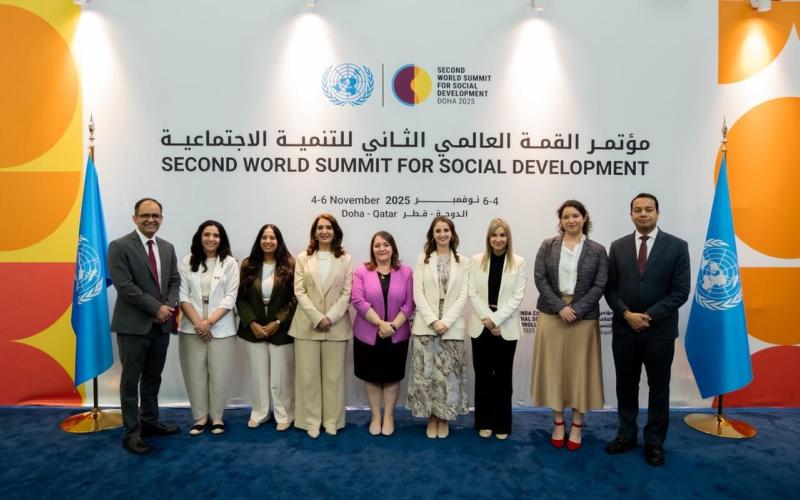
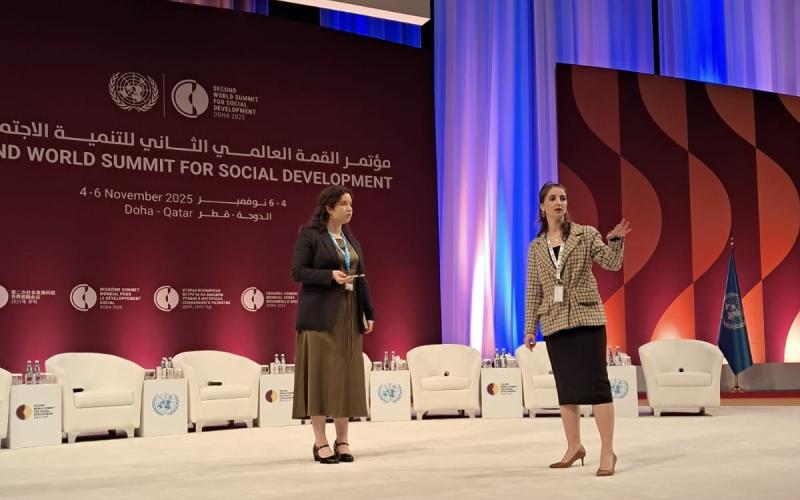
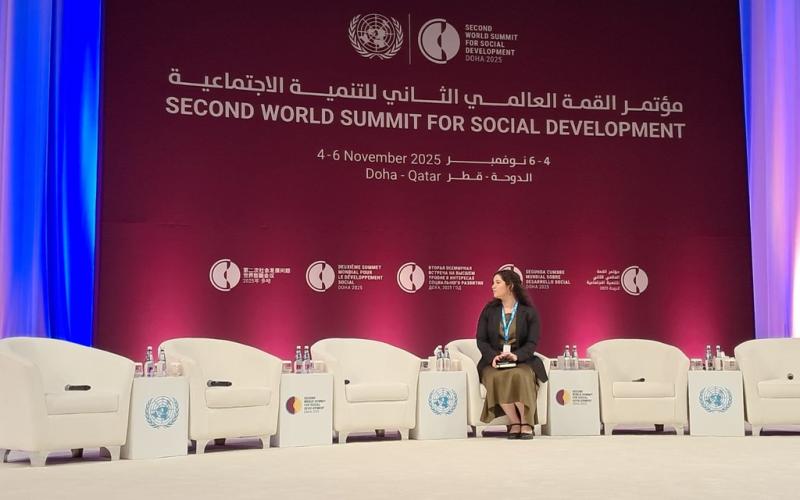
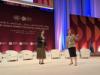

At the beginning of November, I attended the Second World Summit for Social Development in Doha, Qatar. The summit was only three days and it was packed full of sessions, events, and panels. Every event, and every person there, was focused on improving one thing: social development. It was incredible how dedicated and in consensus people were on the need for social development. That effort prompted me to reflect: how can we push even further beyond the current capabilities of United Nations summits, to build upon what we already have? How can UN summits and other high-level multilateral events be enhanced? How can improvement be accomplished?
I attended the Summit on behalf of the NGO Committee for Social Development, through my work as an intern at the Bahá’í International Community. I was part of a small team who planned and executed the Civil Society Forum during the Summit. My role allowed me to go behind the scenes to see how high-level programming is conceptualized, created, and carried out.
On the first day of the Summit, the Doha Political Declaration was formally adopted by the General Assembly. Having such an agreement in itself is of note: the General Assembly was able to agree on key, base level parameters for social development. While it wasn’t perfect and didn’t include endorsements from all states, it is an essential step in significantly improving social development. The fact that it was adopted on the first day of the Summit—compared to the 1995 Summit on Social Development where it was signed on the last day—is also of importance. In my eyes, this expedited process for the Declaration was to allow the Summit to focus on action instead of debating the text’s particulars. The desire for action could be seen throughout the Summit: from the President of the General Assembly’s opening remarks, to the side events being titled “Solution Sessions.” All around the Summit, I was pleased to hear it repeated again and again that action was desired—so how can we work toward it within these multilateral spaces?
Despite the action-oriented verbiage, in practice, it seemed to me that the focus over those three days remained largely on high-level discussions of policies, re-emphasizing the importance of social development, and establishing stances on issues. From my experience and discussion with more experienced staff in the space, it seems that the tendency to stay high-level and simply call for action—instead of planning for it—tends to be a frequent characteristic of international spaces. In my view, the current, standard format of multilateral spaces, while beneficial for reaching high-level consensus or spreading broad information, is less conducive to creating the direct and enduring action that is the overarching goal.
While information sharing and consensus are integral to the functioning and goals of the UN, it could be beneficial that summits and other spaces move past continuous discussion on issues that have a near consensus and that can be acted upon relatively individually. If summits are able to move past this, could it be possible for all participants—Member States, civil society, and the private sector—to leave with actionable, clear plans on how they could implement initiatives, policies, or projects to improve social development?
If the goal is for all participants to subsequently build on plans started at the summit, core conceptions would potentially need to change. Based on my experience as a staff member at a grassroots organization, the following may help to bridge the gap between discussion and implementation:
-
Provide a method for Member States and organizations to publicize their remarks on social development ahead of time, to prioritize action-focused discussion during the Summit;
-
Have more time dedicated to explaining specific strategies, policies, and initiatives that are effective, and facilitate pathways for summit participants to learn how to apply them to their constituents;
-
Encourage a diverse range of focused events/panels so that countries and organizations that handle intricate issues can create actionable, specific solutions;
-
Enable multilateral discussions and planning to happen during events beyond the panelists;
-
Encourage events such as workshops where all participants are able to interact, plan, and build relationships;
-
Acknowledge and plan based on the different strengths and weaknesses of participants;
-
Establish year-to-year follow-up mechanisms that utilize future gatherings—such as Commissions—as check-in points.
Since these ideas can be a bit vague, and specifics are always helpful, I wanted to provide some ideas for potential events that center facilitating action:
-
A workshop—led by a group from a Member State or organization implementing a successful multi-stakeholder solution—on how other participants at the summit can implement it at their level. The workshop could let attendees decide if the solution is applicable to their constituents, begin planning, ask questions specific to their situation, and form relationships with others who wish to also implement the solution;
-
An explanation of a piece of legislation that works to address a specific issue, as well as examples on how it has been implemented in other nations or scenarios. The focus should be on others’ implementation: addressing common concerns with its content or implementation, exchanging insights around how to solve issues that attendees may face as they try to pass/enact it, and answering questions attendees may have;
-
Group sessions where instead of only listening to a speaker, attendees are encouraged to brainstorm solutions with like-minded or geographically similar participants, build partnerships, and establish follow-up plans.
Of course, none of these ideas are a guaranteed improvement on the current structure and intention of any summit. Nor are any of these easily accomplished. Precedent is immensely strong and difficult to go against—after all, even room set-ups in the United Nations are designed for panels and central speakers! Therefore, my goal is simply to keep discussion flowing on how summits and similar gatherings can consistently evolve, improve, and be more conducive to generating action. UN Summits are a powerful tool that can and should continue to improve for the benefit of all.
Kate Mittelhauser is an intern at the Bahá’í International Community United Nations Office in New York