Where is Investment Needed for Sustainability? In New Narratives
By Daniel Perell
Achieving more sustainable patterns of consumption and production is a critical need and requires appropriate investment. But before we can talk about governance and investment, we need to think about the narratives that shape our actions, and recognize where we are in human history.
One narrative is that for most of our history as a species, we have, of necessity, operated in a deficit mentality. In circumstances of deficit, acquisition is the means to survive. We now live in an age of abundance. There is enough food to feed everyone, enough technology to join everyone together, enough resources for all of us to survive. But we continue operating within a deficit mentality. This mismatch between thought and reality produces gross inequalities, including tremendous accumulations of wealth and resources.
Additionally, we have a cultural understanding of progress as consumption. We need to think about concepts of contentment, sufficiency, simplicity, moderation. These find little place in growth-driven paradigms.
To reclaim and expand more sustainable notions will require fundamental changes to our understanding, followed by changes to our systems and structures. Consider, for example, our notions of “developed” and “developing” countries. These are based largely on consumption. If you are able to consume a lot, you are a developed country. If you aren’t, you are considered to be still developing. This will need to change.
Monetization of the things we value is another notion that will need to be rethought. In an economic framework, a certain amount of valuing resources in financial terms is unavoidable. But natural resources have intrinsic worth as well. And just because we haven’t yet learned how to quantify that value doesn’t mean that things we rely on don’t have it.
Once we have a narrative of abundance in our mind, we can start to think in new ways about the role of the state. In many democracies today, for example, policy is highly influenced by polling. Politicians look to polling to see what is popular, and from that adopt positions that will facilitate their re-election. This is backwards in many ways. Our leaders should be defining the narrative required to meet the needs of this moment in history.
In thinking about the kinds of narratives we use to frame our world, and the way we measure progress toward our objectives, I’m reminded of a well-known quote from Robert Kennedy:
Gross National Product counts air pollution and ambulances to clear our highways of carnage. It counts special locks for our doors and the jails for the people who break them. It counts the destruction of the redwood and the loss of our natural wonder in chaotic sprawl. It counts napalm and counts nuclear warheads ….
Yet the gross national product does not allow for the health of our children, the quality of their education or the joy of their play … the intelligence of our public debate or the integrity of our public officials. It measures neither our wit nor our courage, neither our wisdom nor our learning, … it measures everything in short, except that which makes life worthwhile.
What becomes clear is that government has a vital role to play in articulating narratives that define a higher vision of “success”.
When we talk about investment, one area of chronic underinvestment has been in narrative. What is the vision to which we are committing ourselves? How do we invest in people and communities, to help them articulate those very narratives in light of their own circumstances and aspirations?
This includes but transcends monetary investments. We need to think about education. We need to think about trust. We need to think about empowerment in ways that allow local actors to take ownership of their own development.
Institutions of governance are uniquely positioned to foster and sustain generational transition. This can happen through subsidies, compensation, regulatory adjustments, or a variety of technical means of incentivizing needed action.
But our investments and financial flows can be seen as a kind of map of the relationships that exist between various actors. Imagine for a moment that we stripped away all the rhetoric we use and just looked at these financial linkages. What would they reveal about the kinds of relationships between us? What would they reveal about what we value and what we prioritize?
In many cases, we would find that these associations do not match the kinds of relationship we aspire to, in the Sustainable Development Goals and other global agendas. Let us together find ways to overcome the narratives we have inherited, and work to achieve a more sustainable world.
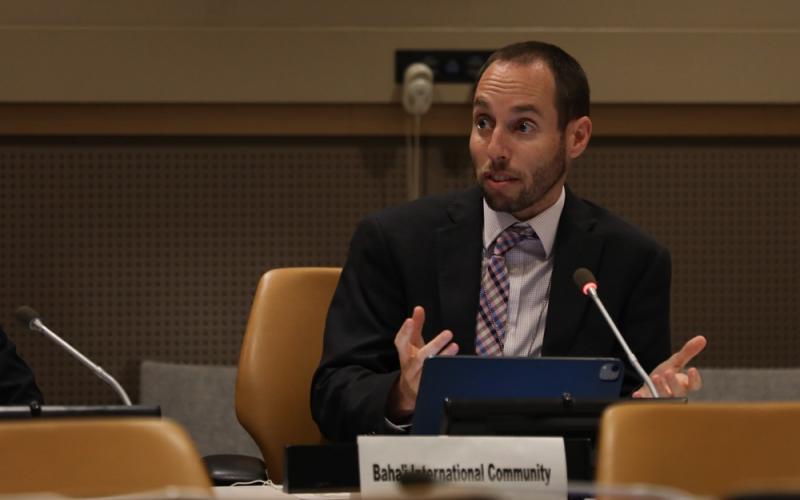
Daniel Perell is a Representative of the Bahá’í International Community to the United Nations
Adapted from remarks delivered at “A resilient recovery for all: Transforming lifestyles and consumption for wellbeing and life on land”, a side event of the High-Level Political Forum on Sustainable Development, organized by the United Nations Environmental Programme