The world as it is? Or as it should be?
By: Daniel Perell
As the Summit of the Future approaches, a perennial debate comes into ever starker relief: should we start with the world as it is and modify, or work to create the world as it should be?
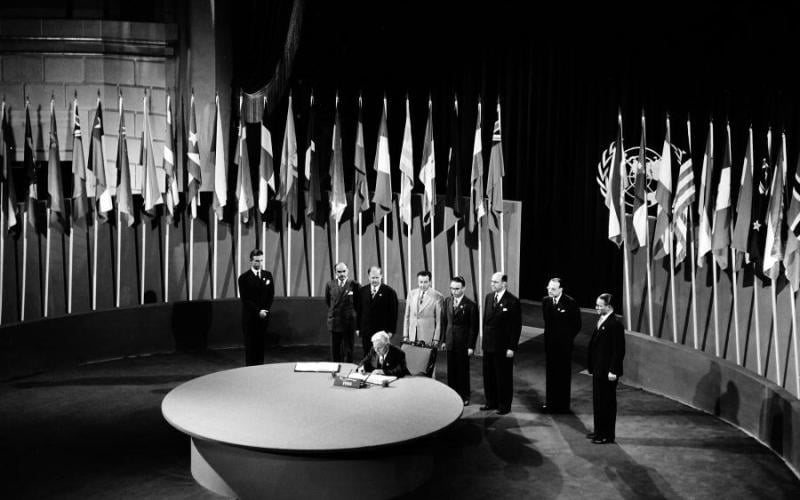
Take, for example, a group that has been exploring possibilities to re-write the UN Charter. My involvement with them has led me to wonder; if we only start with the present Charter as the basis from which we work, remembering it was drafted in 1945 and with that era’s considerations in mind, will we be fated to get only a certain and limited set of outcomes? And if we start with a blank piece of paper, might we arrive at something different? Something better?
Let us apply this analysis to the Security Council—a remarkably contentious debate in international law. Today the Security Council has 15 members, five of whom are permanent and wield a veto power (the P5), while the other 10 rotate on staggered two-year terms (the E10). This is a legacy of the post-World War II era.
If we take this as-is and try to reform it, which many have done, we soon find ourselves expanding the Council, debating the utility of the veto, considering other permanent members, questioning the balance of regional representation, and strategizing to secure the necessary ascent of the P5. These are all valid discussions in trying to solve a challenge that has hindered the UN’s effectiveness for decades. And the Summit of the Future may give rise to a number of the aforementioned modifications.
By contrast, if we start from scratch, a different set of questions and concerns arise. Would we still include a Security Council at all? How might we address the contradictions that arise when perceived national interests are misaligned with global wellbeing? Are there different ways of conceiving a Security Council that incentivizes its members to detach from national or short-term interests? (This is not to say that all Security Council members fall prey to this tendency—but the most pernicious issues often do.)
This question about the world as it is, versus as it should be, arises time and again at the international level; in climate change, gender equality, the international financial architecture, and many other spaces. In a sense, we are trying to balance what is ‘necessary’ against what is ‘possible’. And when these don’t align, we try to take incremental steps, or we run aground and feel a collective sense of despair. But what happens when incrementalism is too, well, incremental, in the face of urgent needs?
We spend ample time at Summits, Conferences and Assemblies trying to modify the world as it is. If we imagine it as it should be, we might even conceive of new answers to seemingly intractable problems.
With something as big as the upcoming Summit of the Future—a title of profound significance—maybe this is a moment when we should err not on the side of caution, but of striving to imagine the world as it should be.
Daniel Perell is a Representative of the Bahá’í International Community to the United Nations