BIC delegates contribute to conversations on global governance at Nairobi civil society conference






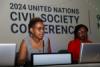

Delegates of the Baha’i International Community (BIC) played key roles in organizing and executing the 2024 United Nations Civil Society Conference, which concluded last week in Nairobi.
The Conference was a key means for channeling input into the upcoming intergovernmental Summit of the Future, and was attended by more than 2,500 representatives from over 150 countries. The BIC delegation included representatives from its New York and Addis Ababa Offices, as well as others from Kenya, Tanzania, and Malaysia.
Notable among the BIC’s activities was a high-level reception to kick off the Conference, co-hosted with the Conference's two Co-Chairs, Carole Ageng’o and Nudhara Yusuf, and the Coalition for the UN We Need. Moderated by BIC Representative Liliane Nkunzimana, the event featured a facilitated discussion to build trust through meaningful relationships among those aiming to improve global governance.
“Solutions to the world's problems are the result of consultation among people with diverse perspectives, coming together on issues of shared concern and building a common understanding together,” said BIC Representative Daniel Perell, framing the purpose of the evening in opening remarks.
The reception drew over 100 high-level Member State, United Nations, and civil society attendees, including UN Under-Secretaries-General for Policy, Global Communications, Guy Ryder, Melissa Fleming, and the UN Office at Nairobi, Zainab Hawa Bangura; along with several Assistant Secretaries-General and over a dozen Member State Ambassadors or Representatives.
Ambassador Neville Gertze, of Namibia, who serves as one of the co-facilitators of the preparatory process of the Summit of the Future, recalled signature successes achieved by the United Nations, while also noting the many areas in which additional progress is needed. “Yes, we have achieved a lot. But there are new challenges we need to sharpen our tools for,” Mr. Gertze said. “These new realities require a new approach of cooperation in global governance.”
Another featured speaker, Ambassador Antje Leendertse, of Germany, the other co-facilitator of the preparatory process of the Summit of the Future, outlined next steps in developing the intergovernmentally negotiated Pact for the Future. “The process will be complex because global governance is complex,” Ms. Leendertse said, while noting the vital role of relationships in navigating such complexity. “Let’s have a conversation tonight based on friendship and a civil society conference based on global friendship.”
Under-Secretary-General Ryder stressed the need for self-reflection in regard to the challenges facing the multilateral system and the role that uncertainties, impunities, and inequalities can play in undermining shared endeavor for the common good. “If you are in a situation where the basic precepts of international cooperation, and the normative basis of that cooperation, are undermined,” he said, “then clearly you are faced with an extraordinarily dramatic obstacle to progress.”
As part of the Conference’s formal program, Mr. Perell was also invited to offer comments during a plenary session. “The future must be built with an eye towards wisdom,” he said, highlighting the need to consider what values should guide our societies. “Wisdom requires the courage to take action based on sound knowledge. Wisdom also demands foresight, responsibility, thoughtfulness, and a long-term view.”
Notable at the Conference was the formation of “imPACT coalitions” as one of the key outcomes—an approach named for the Pact for the Future and framed as an experimental effort to continue action after the Conference itself. Of the 20 coalitions formed, BIC delegates joined in facilitating consultations around three of them, on themes of science and policy solutions for the planet, UN Charter reform, and gender equality.
The BIC also took the occasion to release a working paper of its own, entitled Embracing Interdependence: Foundations for a World in Transition. The paper will inform a statement to the upcoming Summit of the Future, focusing on the practical requirements for “the international community to begin developing a shared narrative—a common story—and to consult on means to foster humanity’s steady movement from global disequilibrium to global equilibrium.” Comments on the paper are invited through this response form.
Immediately following the Conference, Ms. Nkunzimana was interviewed about the experience for a podcast covering international relations, global affairs, and world news. Her analysis and observations can be heard at the Global Dispatches website.